
Why The Five Stages Of Grief Don’t Reflect Bereavement - And What The Dual Process Model Explains Instead
The Five Stages of Grief Model is still widely shared. It’s quoted in books, therapy rooms, Instagram posts and well-meaning conversations.
But it doesn’t reflect how grief actually unfolds for most people.
When Dad died, I tried to map myself onto this linear structure through Denial, Anger, Bargaining, Depression and Acceptance. I wanted a sequence. A shape. A sense that if I could identify the stage, I could move through it "properly."
Instead, I felt exhausted, disoriented and inconsistent. One day I was crying in the kitchen. The next I was on hold with a bank discussing probate forms. Then back to tears again.
That wasn’t a stage failure. It was adaptive movement. The model that actually made sense of my experience was the Dual Process Model of Coping with Bereavement.
What Is the Dual Process Model of Grief?
The Dual Process Model was developed in 1999 by bereavement researchers Margaret Stroebe and Henk Schut.
Instead of describing grief as a linear sequence with stages, it proposes that healthy grief adaptation involves moving between two types of coping:
Loss-oriented coping - engaging directly with the grief itself
Restoration-oriented coping - adjusting to life changes and continuing to function
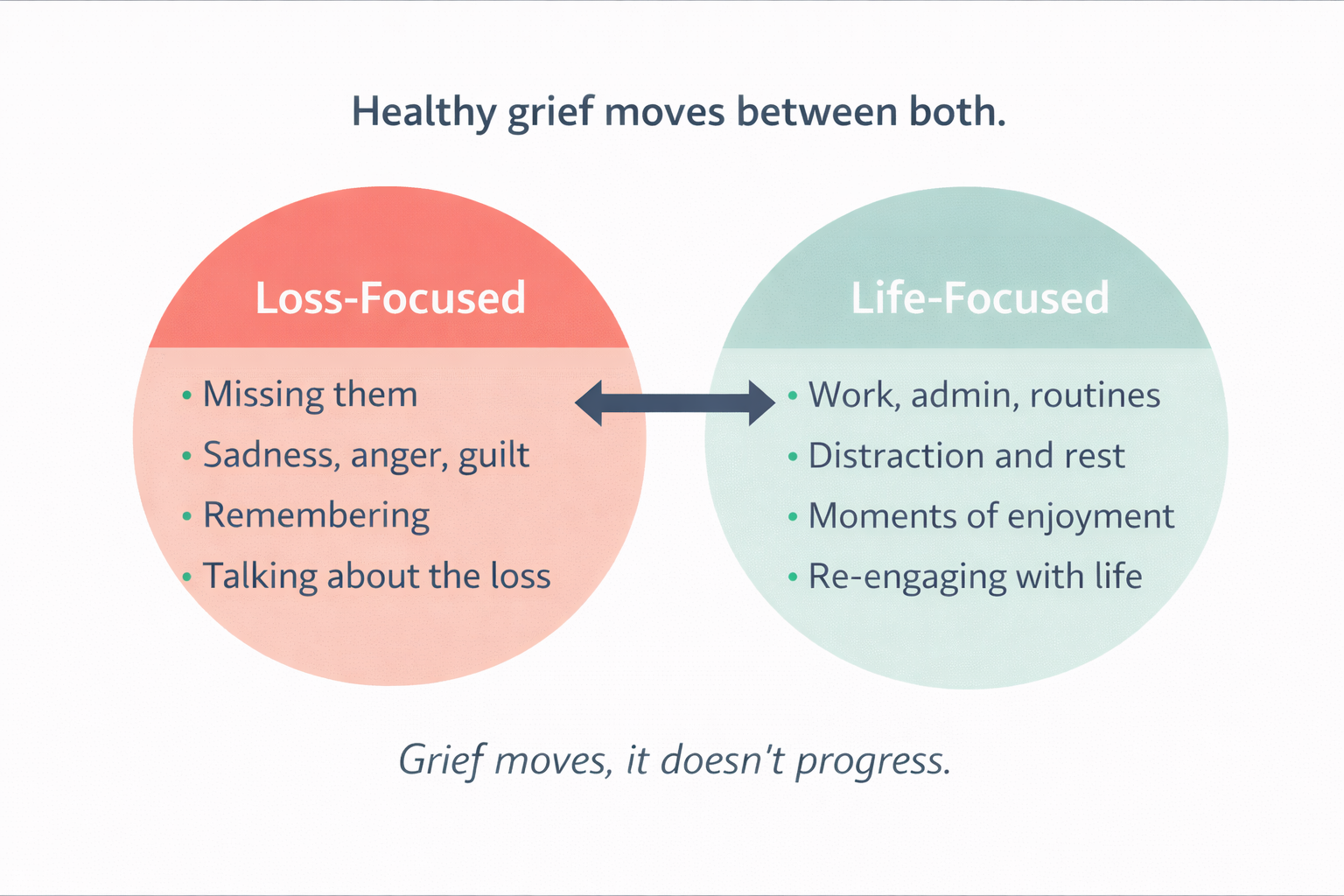
Dual Process Model of Grief And Example Activities by Author
Crucially, people move back and forth between these modes over time in a non-linear way. This movement is called oscillation.
Longitudinal bereavement research suggests that flexibility between these modes is associated with better long-term adjustment. Persistent immersion in grief without relief, or rigid avoidance of it, are both linked with more difficulty over time.
Grief isn’t a step-by-step ladder. It’s variable and flexible.
Understanding The Two Modes
Loss-Oriented Coping
This is what most people imagine when they think of grief.
Crying
Yearning
Talking about the person
Looking at photos
Feeling anger, regret, longing
Thinking about what’s changed
It’s emotional and often physically draining.
Restoration-Oriented Coping
This is where people often feel guilty.
Managing finances
Handling estate admin
Returning to work
Cooking, cleaning, organising
Engaging in routines
Seeing friends
It can look like “coping well.”
But it isn’t avoidance by default. It’s rebuilding your life around grief.
You're Not Avoiding Grief. You're Reducing the Load on a System That's Already Stretched
Focusing on restoration-oriented activities isn’t avoiding grief. It’s making space for it. Life keeps moving, even if we wish it wouldn’t.
I felt guilty every time I dealt with Dad’s finances. Sending death notifications to so many organisations. Filling out forms. It felt like stepping away from what he meant to me and leaving him behind.
But dealing with his estate wasn’t a distraction from grief. It was giving my system breaks from emotional intensity and real pain. And it's not like you don't cry while completing paperwork. You feel longing while sorting admin. Nostalgic waves arrive. You wonder about the "what ifs".
Then you return to the task. It's nervous system regulation instead of betrayal. But when grief stays intense for long periods without relief, stress systems in the body can remain activated.
Research on bereavement shows associations with disrupted sleep, changes in immune function, reduced heart rate variability and increased cardiovascular risk in vulnerable individuals.
That doesn’t mean grief is a disorder as such, unless it severely impacts normal functioning over time. It means loss is a major stressor, and your body is taking a huge hit. If you're curious about how grief impacts the body, read my blog article about the physical symptoms.
Oscillation between loss and restoration gives your system periods of relative recovery instead of constant strain. Functioning doesn't erase love, but allows it to continue without grief destroying you.
Why Our Brains Crave The Five Stages
Linear stage models feel reassuring. It's why the Five Stages Model has stuck around so long in public awareness for so long, even when there are updated approaches to grief and bereavement.
When something destabilising happens, we look for structure and certainty. A staged model promises predictability. Step one. Step two. Step three. All the way to Acceptance and a sense of closure.
But when do loss and grief really feel like that?
From a predictive brain perspective, loss forces your system to update thousands of expectations about the world, about people and about yourself. Who you call. Who you text. Who sits in that chair. Who shows up at Christmas.
You can't update all of that at once, and it's unique for every loss. Your new reality needs to be learned, so you can adapt and adjust to life as it is now and in the future. Oscillation allows gradual recalibration through this learning period (i.e. bereavement). Stages offer certainty, but in a rigid, often unrealistic way.
The Dual Process Model offers realism that works with your bereavement and needs over time.
Five Stages Vs Dual Process Model

Five Stages Of Grief Model vs Dual Process Model Of Bereavement Comparison Table By Author
These models describe grief and bereavement in fundamentally different ways, one as emotional stages, the other as a coping process. Contemporary bereavement research suggests the Dual Process Model more accurately reflects how people adapt to loss over time.
Is It Normal To Feel Like You're Moving Backwards In Grief?
Yes.
The Dual Process Model explains why grief often feels like progress followed by collapse. You might have a functional week. Then an anniversary hits. Or a smell. Or a piece of paperwork. And suddenly you’re raw again.
I still tear up in the middle of LIDL supermarket thinking about Dad. It'll hit out of nowhere, even if I wasn't thinking about him right then. But even if it feels like regression or going backwards in my grief story, it’s oscillation.
New or old triggers require revisiting loss-oriented coping. You give it some attention and then your system shifts back toward restoration again. Adapting to grief means moving through repetition and recalibration, not via straight lines and stage gates.
Grief As A Whole-Body Experience
Grief affects more than emotion.
In the months following a significant loss, research has found associations with:
Sleep disruption
Changes in inflammatory markers
Reduced heart rate variability
Altered immune responses
Increased cardiovascular risk in certain populations
These findings don’t mean grief is pathological. They highlight how closely emotional disruption and physiological regulation are linked.
This is why body-first support matters. When sleep, nutrition, hydration and movement are neglected, emotional processing becomes harder. Our brains and body energy budget are already depleted from dealing with the loss.
Supporting physical regulation by focusing on the basics creates more capacity for grief adaptation and learning over time. Why? Because you’re human.
Moving Forward With Your Grief
If this resonates and you’re tired of trying to grieve “correctly,” or trying to make sense of it all, I’ve created a self-guided workshop called Navigating Grief With Compassion. It includes a fillable Dual Process Model worksheet to map your unique oscillation through grief.
You don’t have to follow stages. You just have to allow movement that helps you adapt and build the life you want in the future.
Sabrina Ahmed
Burnout & Resilience Coach
Learn more at my About page.
